Important: If the case priority is urgent, initial contact should be within 24 hours or sooner if the situation warrants (urgent cases should be immediately staffed with your supervisor to determine plan for response). Priority can be determined under Referral Details on the Report tab.

- Review the specific situation reported and reporter details. Pay attention to any safety concerns noted. Also, review the collaterals and relationship to AV.
- If needed, reporter can be contacted to clarify any information in the specific situation reported
- Review the Notes specifically Screening Note. Look for Safety concerns regarding visit.
- Review AV Vulnerabilities
- Research AV and AP details and update (seek training from supervisor)
- Research OSCN
- Research ODCR
- Research AVA
- Research IMS / Workflow / FACS / OnBase
- Research Harmony
- Research Google Maps
Note: Update the AV and AP contact records as appropriate. If there is concern that a case was assigned in error, duplicate, met merge criteria, etc.; staff with supervisor, and follow supervisor directive.
Important: If you aren’t sure the information from the research above matches the AV/AP, wait to update until after the information can be verified.
- Plan your field visit.
Note: Communicate with your supervisor on how to schedule and conduct an efficient field day. Things to consider are:
- Number of other clients to be seen in the vicinity
- The skill level of the investigator
- The amount of time needed for each potential client to be interviewed
- If law enforcement escort needed
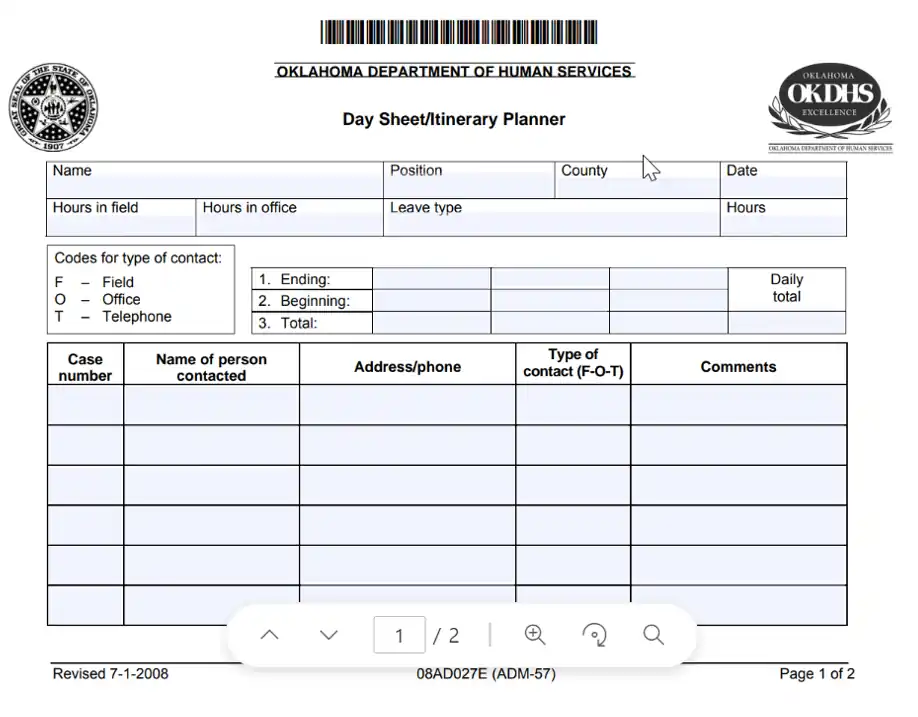
- Utilize your supervisor’s preferred method of contact to let them know that you are going into the field. The picture to the right is an ADM-57 (often referred to as a Day Sheet) is the preferred method for some supervisors.
-
Assess safety concerns
Prior to initiating the home visit, please read the following:
STOP AUTHORITY:
When in the AV’s residence, the APS specialist is particularly aware of any signs of risk to safety. The APS specialist once inside the AV’s residence:
- Stays near an exit and remains alert and observant.
- Pays attention to any unusual sights or odors, particularly those associated with the manufacture or use of drugs.
- Remains aware of the possibility of other persons in the residence and inquires about anyone who may appear to be in another room.
- Leaves immediately if there is risk to safety (this also applies to approaching the residence).
If the visit is ended due to safety concerns, the specialist will relocate to a safe location and contact the supervisor for further staffing.
-
Initiate the initial interview and document interview
Initiate the interview and document whether contact was made or not. If the AV does not answer the door, the APS specialist follows the protocol below prior to leaving the residence:
- The APS specialist attempts to contact the AV by phone.
- When no one answers the phone, the APS specialist calls the reporter to verify correct information.
- When the reporter does not have additional information regarding the AV’s whereabouts, the APS specialist contacts collaterals such as neighbors, doctors, and family to attempt to locate the AV.
- When the first attempt to locate the AV is unsuccessful, the APS specialist leaves a business card and OKDHS Publication No. 17-33, “APS Door Hanger.”
Note: If contact was made on the first attempt in step 9, skip to step 13.
-
If contact was not made in first attempt, make a second attempt within five business days of first attempt to contact AV again. Be sure that you are visiting at a different time of day. Then document interview or attempt. Additional things to consider are:
- The client’s schedule (example: dialysis, adult day care, senior citizen centers, day programs, etc.).
- The specific situation reported.
Note: If contact was made on the 2nd attempt, skip to step 13.
- If contact was not made in Step 10, send AV contact letter and document.
- If no response to contact letter after seven calendar days, look in obituaries, IMS, Google for address or phone numbers, relatives and document in notes. Staff with supervisor regarding possible Unable to Locate decision.
- If it is determined that the case will be closed due to Unable to Locate, go to step 17.
- If client has died, go to step 17.
- If client is located, staff with supervisor for next step.
- Interviewing the AV. *NOTE: Capacity should be assessed throughout the following steps.
- Introduce self, ask who all is present in the home and explain need for private interview with AV.
- Build rapport with client.
- Discuss reported concerns/address all allegations/complete capacity assessment tools.
- Determine services in place.
- Discuss needed services and existing support system that can assist with arranging services.
- Develop safety plan, if needed.
- Distribute Q&A.
Specialist will determine if specialist needs to assist AV in accessing services (applying for SNAP benefits, ADvantage, Meals on Wheels…things that can be initiated online or with a phone call at this interview).
Update AV vulnerabilities on the AV tab with any new information. If determined not a vulnerable adult, staff with supervisor for next step.
- Contact collaterals and document
When talking with collaterals, the specialist should use caution in sharing only the parts of the service plan/details that the collateral will be involved. Collaterals should only be contacted after visiting with the AV, unless contacting the reporter in an attempt to locate AV. - AP
- Preparing to Interview AP
- Determine the AP’s caretaker role based on what was reported
- Allegations being investigated-Exploitation and/or financial neglect may require an interview later in the investigation if specialist needs to request bank records, documents, etc.
- Caretaker Neglect or abuse, request home health, doctor or hospital records, take pictures of injuries, bruising, etc prior to interview
- Safety-check AP history in AVA, ODCR and OSCN, animals or others in the home
- How and where does the interview need to take place?
- Phone, in person, county office, someone else need to be present
- Interviewing the AP
- Determine AP’s caretaker role (may or may not be a caretaker for the allegation being investigated)
- Review AP tab to update Caretaker status.
- Address each allegation reported with AP
- Exploitation and Financial Neglect-Review suspicious/unusual activity on bank records with AP (This should also be addressed with the AV)
- Financial Neglect-Is there a barrier to AP accessing funds to pay for the client’s needs or care? How can it be resolved?
- Once interview has been completed, specialist should document interview in AVA.
- Preparing to Interview AP
- Complete the Risk Needs Capacity Assessment and submit for supervisor approval.
- Client’s desires
- Vulnerabilities
- Specific situation reported
- Ability to access services
- Client’s current services
At this point in completing Service Plan, if needed, further contact can be made with collaterals, alleged victim and alleged perpetrator. Once Service Plan is created, submit for supervisor approval.
- Complete Findings. Once findings are approved, complete Report Findings section of Report Tab.
- Complete APS-2 and forward APS-2 to appropriate District Attorney.
- Send appropriate letters (Findings, Title 30 letter to court, DDS). Copies of Letters and APS-2 will be uploaded to AVA.
- Submit Referral for Closure (review Reasons for Submitting Case for Closure with Follow-Up).
- Supervisor will review case for closure and determine need for follow up.
- If closed with follow-up, case should be monitored at least every 30 days until situation improves to allow closure
- If in follow-up status, all interviews should be documented in the Interview tab as “Follow-Up Interview” type.
- Once situation is stable or resolved, case can be re-submitted for closure.
- If supervisor approves of closure, case will be closed.
- Once all steps are completed, case is successfully closed, and record will be locked.
